
Skip to content
Children First
Get help now
Donate
  • Get Support
    • Get Support
    • Support line
      • Support line
      • Volunteer with Children First support line
      • Communities
    • Advice for families
      • Advice for families
      • Money advice tips for families
      • Guidance & Advice
        • Guidance & Advice
        • Articles
          • Articles
          • Supporting children with additional support needs
          • Coping with stress
          • Death and bereavement
          • Coming home with a new baby
          • Bonding with your baby
          • Looking after yourself with a new baby
          • Behaviour and feelings
          • Managing Children's Behaviour
          • Toddlers and tantrums
          • Teenage behaviour
          • Approaches that work with teenagers
          • Risk-Taking Behaviours
          • Mental Health Issues in Children
          • Common Mental Health Issues
          • Helping your child with mental health issues
          • Challenging or distressed behaviour
          • Spotting signs of abuse or neglect
          • Screen time
          • Online safety and parental controls
          • Sexting
          • Pornography
          • Disturbing or Extreme Content
          • Understanding self harm
          • Bullying
          • Separation and divorce
          • Contact arrangements
          • Supporting Kinship Families
          • Sexual development
          • Healthy relationships and consent
          • Supporting your LGBT+ child
        • Help to protect children
        • Mental health and wellbeing
        • Understanding behaviour
        • New parents and early years
        • The online world
        • Managing difficult changes
        • Sex and relationships
        • At school
    • How we can help
      • How we can help
      • Bairns Hoose
      • Keeping families together
      • Safeguarders Panel
        • Safeguarders Panel
        • What is a Safeguarder?
        • What else should I know?
        • What is going to happen?
        • Additional Support
        • How to Raise a Concern
        • Contact Us
      • Local services
        • Local services
  • Get involved
    • Get involved
    • Gifts in Wills
      • Gifts in Wills
      • Types of legacy
    • Ways to donate
      • Ways to donate
      • Philanthropy
        • Philanthropy
      • Other ways to give
      • In memory donations
      • Payroll Giving
      • About Gift Aid
      • Regular Giving
      • Amazon Wishlists
    • Fundraising for Children First
      • Fundraising for Children First
      • Fundraise at Work
        • Fundraise at Work
        • Sponsored Events
        • Team Building Ideas
        • Make, Bake and Sell
      • Fundraising at school
        • Fundraising at school
        • YPI
      • Contact the fundraising team
      • Do Your Own Thing
        • Do Your Own Thing
        • Fundraising inspiration
        • Birthdays and celebrations
        • Host a cake sale
      • Changing Children's Lives Fundraising Dinner
    • Events
      • Events
      • Kilomathon Scotland 2026
      • Baxters Loch Ness Running Festival 2025
      • TCS London Marathon 2026
      • Supernova Kelpies Run 2026
      • Skydive for Children First (1)
      • Men's 10K Edinburgh 2026
      • Women's 10K Edinburgh 2026
      • Skydive for Children First
      • Kiltwalk Glasgow 2026
      • Kiltwalk Edinburgh 2026
      • Kiltwalk Dundee 2026
      • Kiltwalk Aberdeen 2026
      • Changing Children's Lives Fundraising Dinner 2024
      • The Banchory Bangle Raffle 2026
      • Port of Leith Distillery Abseil 2026
      • The Kelpies Challenge 2025
      • Edinburgh Marathon Festival 2026
      • Take on your own challenge at an event near you!
      • On Mute May
      • Men's 10K Glasgow 2026
      • Women's 10K Glasgow 2026
      • Scottish Half Marathon and 10K 2026
      • 141 Mile Challenge 2025
    • Corporate partnerships
      • Corporate partnerships
      • Charity of Choice
    • Support our appeal
    • FAQs
    • Volunteer
      • Volunteer
      • Children First Support Line Volunteer – Edinburgh
      • Family Wellbeing Volunteer - East Renfrewshire
      • Family Wellbeing Volunteer - Glasgow
      • Family Wellbeing Volunteer - Renfrewshire
    • People's Postcode Lottery
  • Campaigns
    • Campaigns
    • Keeping children safe
    • The impact of trauma
    • Whole family support
    • Bairns Hoose
      • Bairns Hoose
      • Bringing Bairns Hoose to Scotland
      • Changemakers
      • Bairns Hoose news and blogs
      • Bairns Hoose in more detail
    • Children's human rights
  • For professionals
    • For professionals
    • Support line digital toolkit
    • Safeguarders Panel Team
      • Safeguarders Panel Team
      • Role of the Safeguarder
      • Legal Framework for Safeguarders
      • Performance Monitoring of Safeguarders
      • Other Useful Information and Resources
      • Annual Reports
      • Become a Safeguarder
      • For Safeguarders
        • For Safeguarders
        • Policies and Guidance
        • Training and Events
        • Resources
        • Fees and Expenses
    • Family Group Decision Making
      • Family Group Decision Making
      • Family Group Decision Making Accredited Training
    • Online Harm
    • Child Wellbeing and Protection in Sport
      • Child Wellbeing and Protection in Sport
      • Guidance
      • Information on Standards and CWPS Tool
      • Advice and information
      • Training
    • Case management support service
      • Case management support service
    • Kitbag at Children First
  • News
  • About us
    • About us
    • Careers
      • Careers
      • FGDM Coordinator
    • Our Values
    • Leadership
    • Our history
    • Contact us
      • Contact us
      • Historical records
    • Publications
    • Fair Work First Statement
    • Impact report
  1. Home
  2. For professionals
  3. Building a Bairns Hoose
  4. Furniture, Finishes and Materials
  • Introduction
  • The Case For
    • Statements of Support
    • Why Bairns Hoose
    • Bringing Bairns Hoose to Scotland
    • Understanding the Research Evidence
    • Shortcomings of the Current System
    • What Works for Child Victims
    • Limitations of the Evidence
    Statements of Support
    From Bragi Guðbrandsson, Olivia Lind Haldorsson and Dr Mary Mitchell.
    Why Bairns Hoose
    A trauma-informed multi-disciplinary approach.
    Bringing Bairns Hoose to Scotland
    The journey bringing Bairns Hoose to Scotland.
    Understanding the Research Evidence
    The scale of child abuse in Scotland.
    Shortcomings of the Current System
    Re-living trauma, lack of access to support and advocacy, delays and distress in court processes.
    What Works for Child Victims
    The right place, people and support.
    Limitations of the Evidence
    The challenges around measuring long-term outcomes.
  • Participation
    • Participation
    • Children's views about Bairns Hoose
    Participation
    Involving children and young people
    Children's views about Bairns Hoose
    Materials created by children to express their views about Bairns Hoose
  • Building
    • Overview
    • Preparation and Briefing
    • Concept Design
    • Developed Design
    • Technical Requirements
    • Construction
    • Completion
    Overview
    Establishing a strong team and a structured RIBA plan of work.
    Preparation and Briefing
    The business case for the project, planning considerations, impact on local community and key requirements for the house.
    Concept Design
    Developing sketch proposals.
    Developed Design
    Showing what the building will look and feel like inside and outside.
    Technical Requirements
    Building regulations, acoustics, video and sound recording and IT.
    Construction
    Reviewing tenders, awarding the building contract and monitoring the construction progress.
    Completion
    Obtaining a completion certificate, establishing an ongoing maintenance plan, health and safety management.
  • How it Works
    • How Bairns Hoose Works in Practice
    • The Child's Journey and the Professional Response
    • The Investigative Interview
    • Recovery Support
    • Bringing Key Functions into a Bairns Hoose
    How Bairns Hoose Works in Practice
    The role of the coordinator and importance of multi-agency working.
    The Child's Journey and the Professional Response
    Holding the Interagency Referral Discussion (IRD) supporting children to come to Bairns Hoose.
    The Investigative Interview
    The Scottish Child Interview Model and protecting the location of Bairns Hoose.
    Recovery Support
    The Children First Recovery model.
    Bringing Key Functions into a Bairns Hoose
    Social work, education, court and legal process and health.
  • Evaluating and Improving
  • Resources

Furniture, Finishes and Materials

Children First Bairns Hoose logo

When thinking about the design, colour palette, choice of materials and furniture a personal and emotional approach was taken to the process, considering the attributes which are widely thought of as coming together to create feelings of ‘home’.

The aim was to create a meaningful and tangible environment which had layers of interest, texture, and character. Children First were drawn to the Scandinavian aesthetic and knew that they wanted the Bairns Hoose to feel welcoming, cosy and ‘homely’ but that it was important that the different spaces in the Bairns Hoose had the flexibility to be ‘dressed’ or paired back to a simpler scheme, free from visual noise for any children or young people who are neurodivergent. Home is an individual concept which means many different things to different people, so the design team drew on commonly acknowledged positive aspects of a home. In particular, Children First and partners wanted to convey feelings of shelter, safety, warmth, comfort and calm. Even if children & young people coming to Bairns Hoose do not have positive associations with their own homes, it is hoped that their time in Bairns Hoose will allow them to experience the feelings of calm, comfort, and safety which are widely considered to be the attributes of home.

Image credits: Lee Boyd Architects and Will Scott Photography

" Bairns Hoose feels safe and is much more comfortable than being in scary buildings. "
Harper

The team were mindful of avoiding the introduction of objects, smells, patterns or colours that could be considered overwhelming or triggering and utilised a neutral palette of materials. Nothing was introduced that was heavy or oppressive. A neutral, calming tone was chosen for the walls – a soft white that was clean, fresh and had lightness. To add interest a warm, soft greyish blue was used in the recovery room as a highlight colour.

Soft, warm blues, teals and soft greys were chosen for the upholstery with smaller objects such as footstools and small armchairs picked out in a sunflower yellow. A cushion-backed, timber effect vinyl flooring was used in many of the rooms in the house to give the warm and calming appearance of wood, while also offering the durability and maintenance properties required for the operational side of the house.

To flood the building with natural light, where feasible, links were created to the garden using bi-fold doors in the recovery room and fully glazed doors at the entrance and corridor link to the court room and garden space.
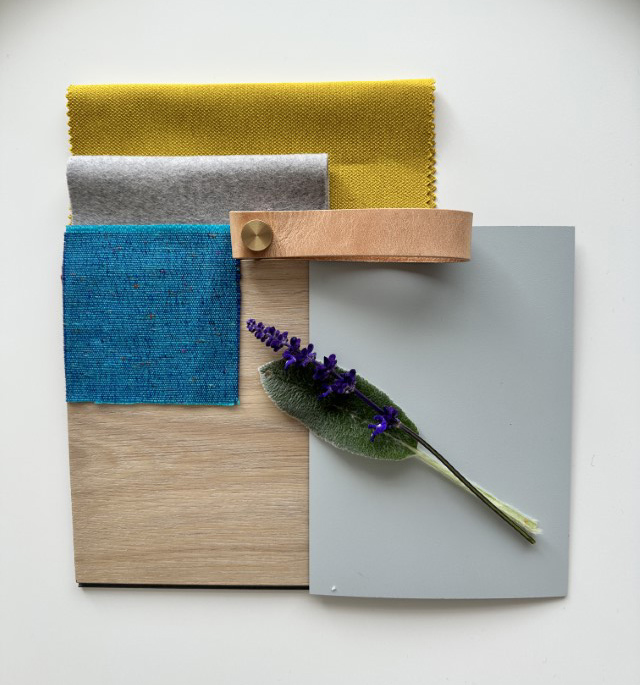
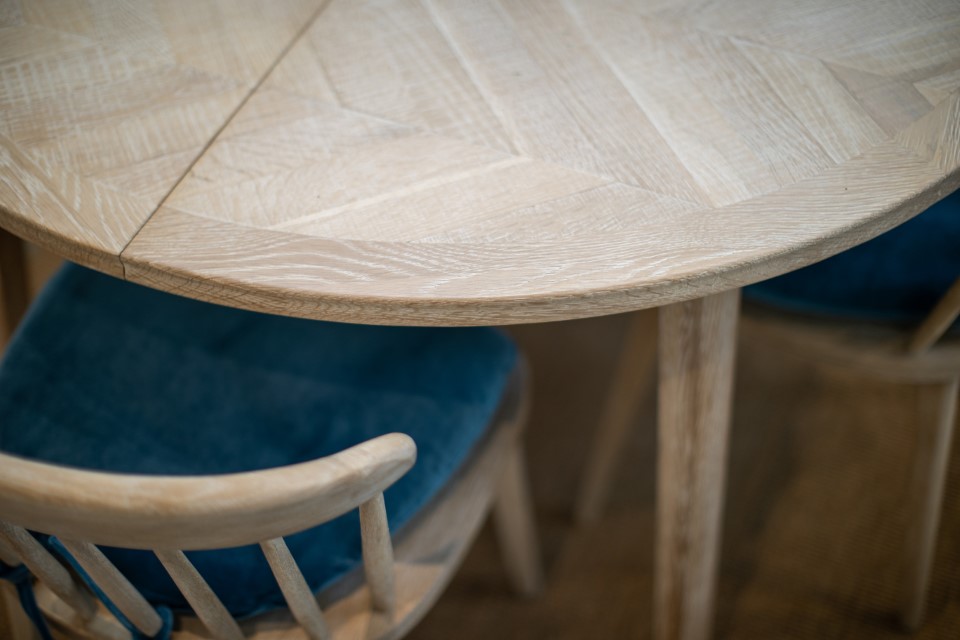
Image of design materials and finishes

Close up of dining table material

Materials were chosen to promote wellbeing wherever possible. Wood is a living, natural material, so oak tables, chairs and coffee tables were chosen and on any upholstered furniture an oak leg was selected. The doors were finished in a paler ash veneer to avoid the wood feeling too ‘heavy’ and dominant.

When it came to sourcing furniture for the project, curved profiles and soft edges were selected to create a human, homely feeling and aesthetic. This included deep sofas with curved backs where people could sit side by side, small armchairs for individual seating and floor cushions for a more informal approach. Large cocoon-like chairs were chosen for children and young people to curl-up in and feel enclosed and a seating nook within a bespoke storage piece was incorporated for a bit of fun.

For relaxation, rocking chairs were added in some of the rooms. Rocking is a self-soothing skill and the repetitive action of rocking helps to calm the mind. Sheepskin throws were draped over chairs to create the feeling of a cosy embrace. Knitted blankets and throws are used heavily across the rooms for warmth, some tucked into woven baskets and others arranged casually across sofas and armchairs to add further layers of texture, softness, and comfort. Interest was created with illustrated ‘face’ cushions. The different faces depicted on the cushions are representative of many different groups with the intention of promoting a feeling of inclusivity. Care was taken in the selection of specific designs to avoid any which might feel threatening. 

Velvet cushions with contrasting piped edging and cushions with large circular wooden buttons, pom poms and tassels add comfort and colour and can also serve as something to hide behind or occupy fidgeting hands. Hanging mobiles in some rooms add some movement and interest at ceiling level. To re-enforce the concept of home, house-shelves were introduced in each of the rooms, inspired by the Childhood Haus in Berlin. Soft, colourful drapes were fabricated using Bute alchemy fabric, is a Scottish wool fabric with subtle coloured, textured flecks & a contemporary take on a traditional tweed. This fabric is used in various colours in conjunction with sheers to help with screening, privacy & add another layer of comfort. Thick rugs were used in rooms to add comfort, warmth and a soft surface to sit or play. Colourful wool felt ball rugs were added in the interview room to create softness and texture.
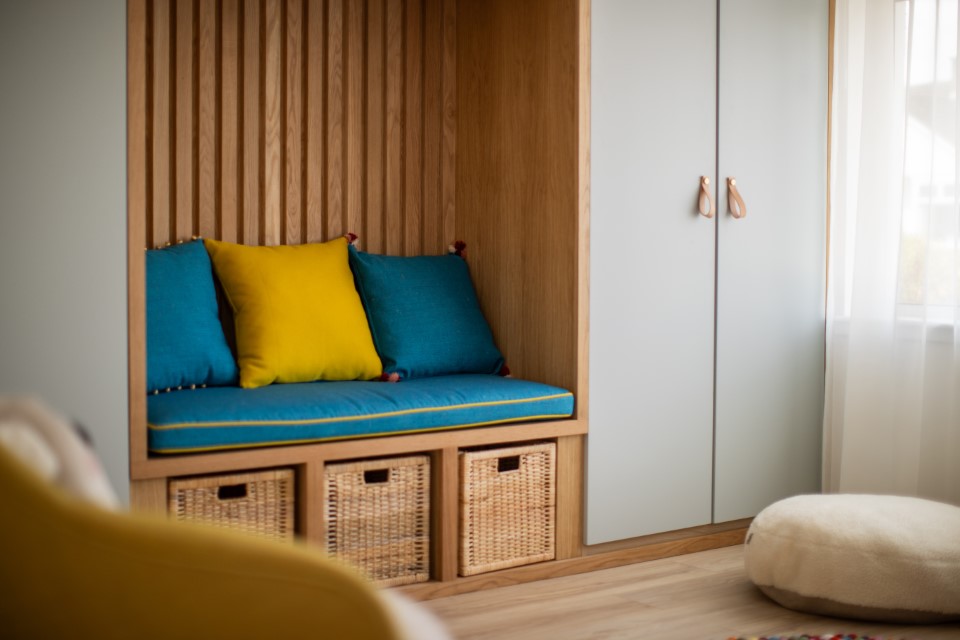
Image of seating and cushion details

Each room has a slightly different aesthetic and loose items are  interchangeable so that the rooms can be dressed or paired back to suit the requirements of the children or young people who are using the spaces. Most of the rooms are square or rectangular with simple plasterboard ceilings and walls, so bespoke built-in furniture was designed for one of the welcome rooms and the court room to create storage, serve as a focal wall and add interest to rooms lacking any form of decorative or ornate details. Slatted, acoustic timber panelling was used in the office, court space and interview spaces as part of the soundproofing measures while also delivering a subtle layer of texture. House plants in various sizes are dotted throughout the house to add greenery & a link with the garden. Lighting in all of the rooms is provided by way of ceiling fixed dimmable spotlights to create an even spread of light and reduce shadows. Floor lamps and small portable lamps create low level ambient lighting more akin to a home.

Next: Planning Consent
Sign up to our newsletter
  • About us
  • Our history
  • Get involved
  • Contact us
  • Donate
  • Careers
  • Cookies
  • Terms and conditions
  • Complaints policy
Find Us On
facebook
instagram
linkedin
youtube
Children First, 83 Whitehouse Loan, Edinburgh, EH9 1AT.
Registered Scottish Charity number: SC 016092. Children First | © 2025
Children First